

Your Firm’s Big Data is Neither Big, Nor Especially Useful
One of the Truly Great Things about living and working in Silicon Valley is that an awful lot of the technology-related claims made by law firms and legal marketers get held up to the sometimes cold, harsh light of people who really know what they’re doing when it comes to technology. This doesn’t always negate these claims, but it does sometimes result in some really useful, if uncomfortable, questions.
There has been a lot of breathless talk about Big Data, and how it’s going to affect the management, marketing and strategy of law firms. It’s my personal opinion that right now, this topic is kind of at the peak of the Gartner Hype Cycle. In case you’re not familiar with it, the Hype Cycle is a graphical depiction of the stages new technologies go through in their markets. It looks like this:
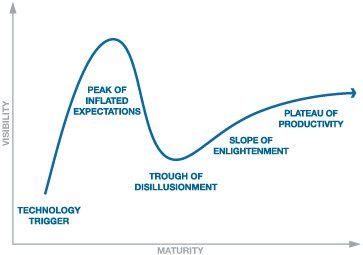
Basically, what this means is that when it’s new, a technology is often grossly oversold, overhyped, and a lot of early adopters will not get results. Which leads to the next step, the Trough of Disillusionment, followed by a gradual climb back out.
I would argue that law firm strategists and marketers are doing this right now with respect to the impact so-called Big Data will have on their businesses.I think we may be at the Peak of Inflated Expectations. Here’s an example — this is from an article in the American Laywer last year:
In fact, law firms are data sieves. They are swimming in data with which they do little but the most rudimentary financial analyses, largely for compensation purposes. Big law firms have hundreds of thousands, if not millions, of digital interactions with clients and prospects daily and then do nothing to mine the data. There are emails, voicemails, bills, briefs, memos, other documents, fact patterns, decisions, website visits and untold other digital interactions. Firms work with public data every day: cases, statutes, regulations, rulings and opinions. Terabytes of data course through firms and are dumped in cyberspace garbage cans called servers (most of them cloud-based).
Now, is the potentially great value in analyzing all of this data? Yup — there’s information in there, and some of it may turn out to be strategically or tactically really important. However, I think there also needs to be a realistic understanding of what actually doing this in the physical universe we collectively inhabit actually requires.
Here is an article published yesterday in Techcrunch by a guy from a startup in Boston that actually does some of this stuff. he develops tools for working with big data.And guess what? It’s hard. It can be extremely expensive. It has to be done very carefully. And it’s often not the magic solution people sometimes think it is. A few specifics from the article (the actual text is in italics):
What you’re doing isn’t Big Data: But marketing materials, like fishermen, exaggerate. Most companies only have a fraction of the data they claim. In other words, you probably don’t have as much data as you think you do.
Most of your data is useless: If most large datasets are useless, why talk about them at all? Because they aren’t useless for everyone. Deep-learning models can separate signal from noise, finding patterns that would typically take experts months to codify. But typical deep-learning models only work on massive amounts of labeled data. And labelling a large dataset takes hundreds of thousands of dollars and months of time. That’s a job for a corporate behemoth like Facebook or Google. Too many smaller companies don’t realize this and acquire massive data stores that they can’t afford to use. In other words, you have to organize, label or structure data to work with it, which can be fantastically expensive.
The results of your data analytics may be useless, too: And typically, only a small fraction of that fraction is useful for generating any non-trivial insight. In other words, once you’ve analyzed your data, and you’ve come up with some kind of insight or conclusion, you have to be able to do something with it or about it, and what you can do has to be meaningful. Knowing that a statistically significant percentage of your clients are hockey fans is pointless.
The source of this often unrequited love firms and consultants have for Big Data springs, I think, from examples like Google, Amazon and Facebook. Here’s another paragraph from the same American Lawyer article:
More brazenly, Amazon sells you what you want at a razor-thin margin and, practically speaking, delivers it for free, just so it can analyze your data to pitch you on what other people who bought what you bought also bought. Imagine the cashier at the grocery store telling you that the last person who bought what you just bought also bought laundry soap, causing you to remember that you need laundry soap, too. That’s Amazon. It has perfected figuring out what else you will want to buy, based on what you just bought. Unlike Google and Facebook, both of which are highly profitable, Amazon is on schedule to lose nearly a billion dollars this year. Yet because it has figured out, like Google and Facebook, how to collect and create value from data, it is one of the most valuable companies in the world.
Okay, listen to me now. Please? What someone like Amazon, or Google, or Facebook, does with their data has absolutely nothing — zero — to do with what you should do with yours. They are in a completely different industry, which each of these three companies basically invented. They are transaction and ad-sales companies, not professional services firms. And most importantly of all, they generate and manage data on a scale that no law firm in the universe can even comprehend. Google processes 50,000 searches every second. The use about one-fourth of all the bandwidth used by everyone on the planet. They have built and own fourteen data centers around the world — it’s hard to even conceive of the amount of data just one of them can hold. If you want to try, watch this. These places are so big that engineers move around inside the building on scooters.
Now, this is not to negate the potential impact of data. Not at all. I have consulted to data analytics companies, and what they can do is truly a wonder to behold. However, be very careful of comparisons.
What these guys do has nothing at all in common with what your firm can do. Or should do. The bottom line here is simple — when you’re thinking about the promise of Big Data for your firm, ask a lot of very pointed questions about what, in the end, you can actually do with this data. The answer may be far less than you think.